Wednesday, February 5, 2020

Japan provides $1 Million grant for Sri Lanka


The Government of Japan supported the Mines Advisory Group (MAG) for humanitarian demining activities in Northern Sri Lanka with a total sum of US$ 635,420 (approx. Rs. 110 million), the Japanese Embassy reported.

At the Ambassador's Residence in Colombo on 28 November 2019, Japanese Ambassador to Sri Lanka Akira Sugiyama and MAG Country Manager Valentina Stivanello signed the grant agreement.
The agreement follows two other grants from the Japanese government for a similar purpose in October this year – to promote and encourage the relocation and rehabilitation of farming and other livelihood activities for internally displaced persons (IDPs).
Experts predict that this project will continue the ongoing mine clearance in the northern region and contribute directly or indirectly to livelihood improvements for over 2,000 families in the districts of Mannar and Vavuniya.
Since 2003, Japan has been a significant donor in Sri Lanka in the field of mine clearance to help the nation to be mine-free by 2020. More than US$ 36 million in assistance was rendered towards this cause through its Grant Assistance for Grassroots Human Security Project (GGP).
Therefore, this project will contribute to the efforts of the Sri Lankan government to ensure safe mine-contaminated areas, facilitate the resettlement of displaced people and enhance their livelihoods in the northern region, especially in the districts of Mannar and Vavuniya.
OSL Take: The statement by Japanese Ambassador to Sri Lanka is indicative of the success recorded by foreign investors who have set up businesses based in Sri Lanka. It is also indicative of the opportunities to engage in companies as well as the availability of skilled labor in the country.
Sri Lankan government has also taken many steps to improve the ease of doing business environment in the country and has made massive progress in infrastructure development as well.
Sri Lanka’s geographical positioning, along with the many trade agreements and trade concessions enjoyed by the country, makes it an attractive business destination.
Therefore, foreign businesses/investors could explore setting up businesses in Sri Lanka as the base for the South Asian region.
Finally, we see a Japanese big fish taking to the “investment waters of Sri Lanka.”
Now the “eyes” of the international investment figureheads and pundits will stretch with anticipation about the investment potential of Sri Lanka.
OSL has been upbeat about the country’s potential.
However, many still went on the “wait and see policy” to take part in the country’s all sector boom. The boom was spearheaded by the USD 44 billion Western Region Megapolis Masterplan (WRMM) aimed at making Colombo a dominant trading-hub by 2030.
So, any party willing to consider Sri Lanka as a worthwhile investment destination could now consult the biz-friendly OSL Team for a country overview and the smart-investment-way forward with our local expertise and active links.
VBS/AT/05022020/Z_TB4                                                  

HSBC, IUCN to conduct a study on the Sri Lanka apparel sector


HSBC Sri Lanka, in partnership with the International Union for Nature Conservation (IUCN), has launched a survey to plan greener processes in the apparel industry.

The survey will be focusing on small and medium-sized producers, officials said.
"The apparel industry is a vital income earner for Sri Lanka, and supporting its shift to greener development is crucial for the industry's growth and long-term stability," said Mark Prothero, Chief Executive of HSBC Sri Lanka and Maldives.
"HSBC is moving beyond transactional corporate social responsibility with this project to a more knowledge-based contribution that benefits communities, the environment, and the country as a whole."
"And hopefully the result of this study will be a strategic guide on how small and medium-sized apparel producers can reduce their carbon footprint by becoming greener and more sustainable," he said.
The apparel industry in Sri Lanka is by far the largest export earning industry with sales of US$ 5 billion and has a significant environmental impact. To achieve sustainability, the more substantial industry players have transformed over the years into greener manufacturing methods. Sri Lanka's Chief Financial Officer, Brandix Lanka Limited, Suchitra Surendranath, representing the Joint Apparel Association Forum (JAAF), spoke at the event describing Brandix's steps to create Sri Lanka's first ' net zero carbon ' factory in Batticaloa.
"Typically, 44 percent of power is used for air conditioning in a garment factory," he said. "For example, magnetic bearing chillers could save up to 42 percent of that consumption as compared to rotary chillers."
He further commented, saying, "Replacing conventional LED lighting, gripping servo motor motors, and installing biomass boilers instead of gas boilers are a few steps you might take to create greener garment.”
Sustainable investment has the potential to contribute to several UN Sustainable Development Goals (SDGs) in the fashion and clothing industry. These include providing and maintaining water and sanitation, building robust infrastructure, inclusive and sustainable industrialization and development, integrated, healthy, stable and sustainable communities and human settlements, and fighting climate change and its impacts.
IUCN Country Representative Ananda Mallawatantri said that the strategy would be implemented with the assistance of industry and government officials from organizations such as JAAF, the National Cleaner Production Center (NCPC), and the Investment Board (BOI).
"The consultations envisaged during the development of the strategy will include regulatory agencies, senior managers of the apparel industry and technical staff, environmental auditors who are familiar with the operations and processes of the industry," he said.
OSL Take: The statement by HSBC on Sri Lanka’s apparel industry experts is a clear indication of the continuously growing business/investment opportunities in the country’s apparel exports sector. The growth in sales recorded by Sri Lanka’s multinational textile manufacturer shows the business potential in Sri Lanka’s apparel manufacturing and export sector.
Sri Lanka enjoys the GSP Plus trade concession from the EU and the US GSP facility, which provides added incentives to local manufacturers and exporters. Relationships with fresh clients will diversify the export industry that is needed because of U.S. import dependency. This emphasis will also be here to create long-term relationships with global brands that can enhance the apparel sector. The need to capitalize on automation and the target of US$ 6 billion in apparel export earnings is a beckoning call for foreign businesses/investors to explore business/investment opportunities in Sri Lanka.
VBS/AT/05022020/Z_TB3

Financial research and analytics giant Acuity Partners to invest in Sri Lanka


Acuity Knowledge Partners (formerly a Moodys Corporation subsidiary) are new owners of research and analytics companies. They are committed to expanding their operations in Sri Lanka and believe it is the fastest-growing location among their international distribution centers.

Moody's Analytics Knowledge Services (formerly Amba Research) announced their rebranding as Acuity Knowledge Partners last month. It followed a management buyout from Moody's Corporation, backed by Equistone Partners Europe Ltd. (Equistone), European mid-market private equity investor.
Acuity is a leading provider of customized research, analytics, and automation technology for the financial services industry. Established in Sri Lanka in 2003, Acuity has offices in the United Kingdom, the United States, India, Costa Rica, and China.
The Investment Director of Equistone, Richard Briault, and Partner of Equistone, Tim Swales, were in Sri Lanka, to announce the new ownership and branding. Acuity CEO and Director Robert King joined them.
Acuity has a broad client base of more than 300 financial services firms in fields such as investment banking, investment management, private equity, advisory, and commercial lending. It hires more than 2,500 professional analysts worldwide, with Sri Lanka comprising around 10% of them. In July this year, while Acuity revealed the change in ownership, the company posted a third-quarter record. "We are pleased that the market responded to the announcement positively. Customers respect our quality and experience," Robert said.
"Our staff knows we have a strong supporter in Equistone, and the company is doing well, and we're investing in Sri Lanka. We opened new distribution facilities which this year will lead to an increase in numbers of 20 percent. Next year we are expecting similar growth. Sri Lanka is going to be our fastest-growing site, "Robert announced.  Together with Equistone, Robert, as CEO and co-investor, acknowledged and included the tenured analyst pool of Acuity in the ownership structure. The analysts are its most significant resource, representing more than 300 of the top financial corporations in the world. "As an employee from day one, I can tell this movie has had a tremendous impact on motivation," said Chanakya.
Robert was emphatic that Acuity aims to be the global financial services sector's # 1 marine research and analytics partner. "We believe we are the biggest and leading player, and we want to grow stronger and stronger." He said it was equally important to continue creating an excellent business for customers and an exceptional workplace for workers, where they have career opportunities and a committed and supportive management team that will invest in further development and learning.
OSL Take: The decision to expand in Sri Lanka is an expression of confidence in Sri Lanka’s economy and growth. These words encapsulate the importance of Sri Lanka in the Indian Ocean region and would undoubtedly provide many reasons for foreign businesses/investors to explore opportunities in the island nation.
As pointed out by the research company, Sri Lanka has shown excellent signs of returning to normalcy following the Easter Sunday attacks. Also, the resilience shown by the island when faced with adverse situations has increased business/investor confidence in Sri Lanka. Therefore, foreign businesses/investors could explore business/investment opportunities in Sri Lanka.
VBS/AT/05022020/Z_TB2

An analysis of State-Owned-Enterprises (SOEs) in Sri Lanka

Today, airports, ports, roads, power plants, railways, etc. are operating around the world through private sector and public-private partnerships.
When traveling abroad, Sri Lankans don't think twice.
The same holds when they fly on private airlines, land in private airports, go on private toll roads or get their electricity from individual power plants.
However, over the 70 years since independence, the leaders of Sri Lanka have not dared to emulate this global phenomenon locally. Neither have our private sector leaders had the vision or drive.
The Pathfinder Foundation launched a table of underused government assets in 2015. The launch of which came with the election of the 'Yahapalanaya' government, whose sentiments were that these assets should be sold to private investors or opened up to private-public partnerships.
The sale of these assets was to both raise government revenue and, more importantly, kick-start a moribund economy.
Since these recommendations were not notified by either the then government or the private sector, the Pathfinder Foundation again presents this table, entitled 'Broad-based SOEs: Increasing efficiency, debt reduction, and revenue generation,' in the hope that this proposal will be considered by the new government when formulating policy and that these proposals will be included in their lobbying initiatives by the private sector.
There are 422 government-owned enterprises (SOEs) in Sri Lanka, contributing 13 percent of GDP, based on the currently available data. Nonetheless, for various reasons, including legal definition, the exact number of SOEs is open to question. Fifty-four classify as strategic state-owned enterprises (SOEs) out of this number. These SOBEs' total asset base stood at Rs. 7.6 trillion by the end of 2017, 57 percent of GDP.
All SOBEs' total net profit amounted to an Rs. 27 billion loss in 2018. There were 17 SOBEs, which incurred aggregate losses of Rs — 158 billion, which outstripped others' aggregate income. The profits were reported primarily from government-owned banks and non-bank financial institutions as well as trust funds. Ceylon Petroleum Corporation (Rs. 104bn), Ceylon Electricity Board (Rs. 30bn), and SriLankan Airlines (Rs. 17bn) reported the most significant loss. The government also collected Rs. 37bn as levy income and Rs. 4.6bn as SOBE dividends.

OSL Take:
The new amendment to foreign exchange legislation enabling Sri Lanka’s state-owned enterprises to borrow monies from external sources would result in the expansion of operations in many state-owned enterprises.
The latter would invite more open as well as direct transactions between foreign business/financial institutions and Sri Lankan state-owned enterprises.
Once the government introduces the reforms to SOEs, it will make them less risky for private investment. The reforms, coupled with the GoSL’s stance on promoting PPPs, will contribute to more profitable public-private partnerships (PPPs) signed on concerning SOEs. Therefore, foreign businesses could explore opportunities for trade with Sri Lankan state-owned enterprises.
VBS/AT/05022020/Z_TB1

Tuesday, January 14, 2020

World Bank Chief Economist positive about Sri Lanka


Sustained high growth in South Asia depends on government's relentless commitment to structural change. The structural change includes the reversal of protectionism and integration with the global economy, a prominent economist said this week, warning Sri Lanka may not have the necessary fiscal space for ambitious stimulus.
Hans Timmer, Chief Economist for South Asia at the World Bank's Center for Banking Studies on Tuesday, delivered a public lecture entitled 'Global Economic Outlook and Challenges with a Focus on Sri Lanka’. In the speech, he said South Asia was seeing a sharp decrease in its growth projections after five years of being the fastest-growing region in the world.
He indicated out that the main reason for this was because South Asian nations were affected by global economic challenges. He also said that governments had added them to the existing internal structural problems with which the countries had been struggling for decades. In response to questions, Timmer also cautioned about the wide-ranging economic stimulus package proposed by the government last month and noted that policymakers would have to strike a delicate balance so that fiscal policy loosening would not lead to economic overheating.
"Try to mitigate the impact by counter-cyclical policies is what you usually do in a situation like this. Especially when viewed as a temporary slowdown, fiscal policies seem to be very successful. If there are structural problems, making changes to monetary policy tempts governments. Nonetheless, there is no fiscal space to participate in counter-cyclical procedures in South Asia's big problem. The lack of fiscal space is valid for most South Asian countries because they didn't build any reserves they could use in tough times in the past.
"It's a challenge for Sri Lanka. Fiscal stimulus is appropriate, but there may not be space to do so. You also need to be careful to maintain the right balance because if you over-stimulate and there is no room, then you could destabilise the economy while trying to do the opposite, "he said.
Several institutions and experts, including the World Bank, have urged Sri Lanka to pursue reforms that would see crucial structural changes in its economy, including continued fiscal consolidation, by broadening the tax base and allying spending with priorities; Shifting to a private investment-tradable sector-led growth model by improving trade, employment, innovation and the business environment; improving governance and SOE performance; addressing the effect of ageing workforce by growing labour participation, promoting longer working lives and investing in skills to improve productivity; and mitigate the impact of reforms with well-targeted social protection investment on the poor and vulnerable. Timmer acknowledged that Stimulus would not sidestep the need to pursue such efforts.
In addition to standard problems such as infrastructure, urbanisation, energy, water protection, and environmental issues, according to Timmerman, South Asia also has concerns that are special to the country. In Timmerman's view, this not only leads to underproductive economies and less attraction for investment, but a limited formal sector can also lead to problems such as low participation in the female labour force.
OSL Take: The World Bank Chief Economist for the South Asia Region is visiting Sri Lanka to gain further knowledge on the country’s development agenda. The Bank and its subsidiaries have already pumped in large amounts of monies for development projects covering several vital economic sectors. Further improving the discussion between the World Bank and the Sri Lankan government would result in a further increase in development assistance to the island nation. An increase in development assistance is an encouraging sign for foreign businesses/investors keen on doing business with Sri Lanka since the interest shown by multinational lending agencies would help secure funding for largescale projects.
VBS/AT/20200114/Z_TB1

Monday, January 6, 2020

Sri Lankan Government to review LNG power plant


The government decided yesterday to discuss the Kerawalapitiya LNG plant with Mahinda Amaraweera, the new power, and energy minister, calling for a detailed report on the matter.

Minister Mahinda Amaraweera said that the ministry would decide on the Liquefied Natural Gas (LNG) power plant tender. The decision will follow the submission of a comprehensive report, “Passenger Transport, Power, and Energy.”
The Minister has demanded a document reviewing delays in the LNG power plant project and awarding the tender to a foreign company. However, a decision will be made based on its content.
"We're going to look into whether the tender can be re-issued to a local business," he said. "The lowest bidder was LTL Holdings, a subsidiary of the Ceylon Electricity Board. However, the tender was issued to a Chinese-owned company," explained Amaraweera, adding that the ministry proposed the LNG project in 2016. Meanwhile, the ministry’s scheduled deadline for completion of the project has passed.
The ministry will discuss the report on Thursday. In a statement issued yesterday, the Passenger Transport, Power and Energy Ministry said the country suffered a loss of more than Rs. Ninety billion as a result of this deal.  The statement added that despite a local company offering the lowest bid, the ministry awarded the tender to a Chinese-owned company. Henceforth, in conjunction with the bidding of some officials of the Ministry, the award was compensated.
In February, Cabinet approved the establishment of a 300 MW LNG power plant in Kerawalapitiya by the consortium of GCL China Windforce and RenewGen. It was to be one of two approved LNG power plants through a Cabinet paper presented by Ravi Karunanayake, former Power and Energy Minister.
They were to be the first plant to be built after the completion of the Lakvijaya Coal Plant nearly a decade ago in Norochcholai. Since 2013, the Ceylon Electricity Board (CEB) has been unable to commission any new power plants included in its Long Term plants.
OSL Take: The decision to review the LNG terminal of its own is a positive development in the country’s power and energy sector. Sri Lanka is presently facing a power crisis. The power crisis is likely to get worse by 2020. The Government of Sri Lanka is in the process of looking at ways to mitigate the looming power crisis expected to hit the nation by 2020. Sources say the annual increase in power consumption may be two-fold in the next three years. Therefore, the government decided to expand into this alternative energy generation source will help mitigate Sri Lanka’s energy crisis.
The latest Cabinet approval will allow energy companies that use LNG to generate electricity in other parts of the world.  The former may allow entry into the Sri Lanka energy market and spearhead this new initiative.
It will also allow energy corporations to submit proposals for other innovative and cost-effective methods of generating power as Sri Lanka’s Cabinet appears to be receptive to such progressive recommendations. Therefore, Sri Lanka’s power andenergy sector have many opportunities for foreign businesses/investors toexplore.
VBS/AT/20200106/Z_TB6

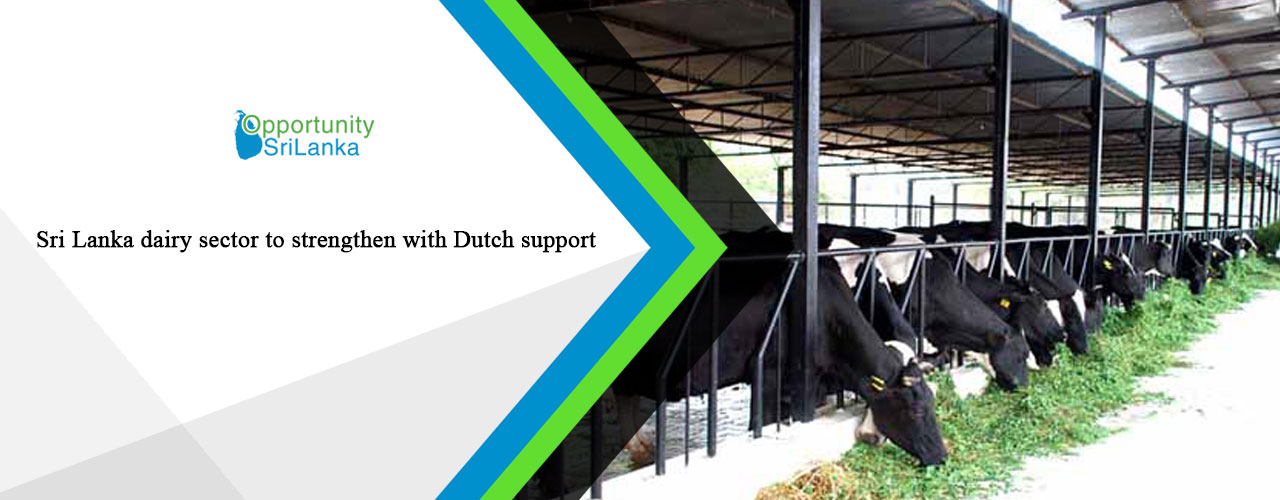
Sri Lanka dairy sector to strengthen with Dutch support

Sri Lanka is setting up a training centre to enhance knowledge in dairy farming. The Netherlands is supporting the centre, one of the world's most advanced dairy farming and processing industries.

"Agricultural education in the Netherlands has brought our small country from one of the subsistence farmers to one of the world's largest agricultural exporters," Kingdom of the Netherlands Ambassador to Sri Lanka Tanja Gonggrijp said at the training centre's launch.
Sri Lankan Association of Animal Production (SLAAP) has set up a training centre for dairy production. The centre is the collaborative result of the University of Peradeniya with backing from the Netherlands.
Nishan Dissanayake, the Senior Agricultural Policy Advisor at the Colombo Dutch Embassy, made the following statement:
"The Netherlands Embassy has carried out many analyses to better understand the developing prospects in the dairy sector in Sri Lanka.”
The proposed Dairy Training Centre will provide a skilled work-based learning path with recognized practical, hands-on skills, both locally and internationally, with short-term and full-time courses certified by the initiative's partner university.  The following dignitaries signed the MoU (Memorandum of Understanding) agreement for the centre.
    1.       Upul Dissanayake, University of Peradeniya's Vice-Chancellor
    2.       Ajith Gunasekera, SLAAP President
   3.       Jan Jeronimus, Sri Lankan Dutch Dairy Solutions Coordinator
The training centre will have a dairy farming complex for a typical farming business with 125-150 cows, a processing facility, computer storage, bunker, silos, and manure storage. It will also have operational study classrooms, boarding and lodging facilities, as well as a separate set of livestock. 
The Sri Lankan Dutch Dairy Solutions Manager Jan Jeronimus commented on the development. He explained that in the Netherlands, it is not possible to blindly copy-paste the things done in the dairy sector as there is a very different context in Sri Lanka. However, it is possible to copy-paste the underlying principles such as good food, animal health care, universal principles of reproduction.
According to some experts, the small dairy farmers in Sri Lanka obtain a yield of about 5 to 6 liters of milk. This yield is partly due to weak genetics, poor feeding practices, and a lack of knowledge on animal care that leads to stress.
Some experts say that yields can improve without genetic enhancement.
It is said to be the result of better feed and treatment which reduces stress. The government of Sri Lanka imported and distributed high yield cows to small dairy farmers, but many died or became sick. According to dairy farmers, Sri Lanka also has a shortage of veterinary surgeons in many regions.
Ambassador Gonggrijp says that there are also activities in the global dairy industry that reduce the environmental impact.
"We should not only look at how much is made but also where it is manufactured and under what conditions if you want to create a sustainable environment," said Ambassador Gonggrijp.
She said the government of the Netherlands had imposed rules on farmers to make the livestock sector more environmentally friendly. "Because the dairy sector is in its infancy, Sri Lanka has a rare opportunity to avoid these situations," she said. "And by actually developing it right from the start, you won't have such problems in a safe so robust way, at least in this case." Climate change advocates have argued that methane and nitrous oxide from burping and moving cow gas and manure helps to cause 'climate change.'
OSL Take:  Sri Lanka is working towards becoming self-sustained in dairy milk. Authorities have carried out many development programs targeting the upliftment of the dairy milk industry. Such programs have resulted in the expansion of business/investment opportunities in Sri Lanka’s dairy industry.
VBS/AT/20200106/Z_TB5